It is Thursday night and you have one sit on Saturday, with a northwest wind in the forecast. You have a saved Plan with three setups and a note about a buck crossing the creek bottom at first light. Ask Reckonar is where you talk that through with something that has read your ground.
The short version
- 01Ask Reckonar is a chat about one Hunt Area. It reads Reckonar’s analysis of that ground, your saved Plans, and the notes and pins you and your Camp recorded.
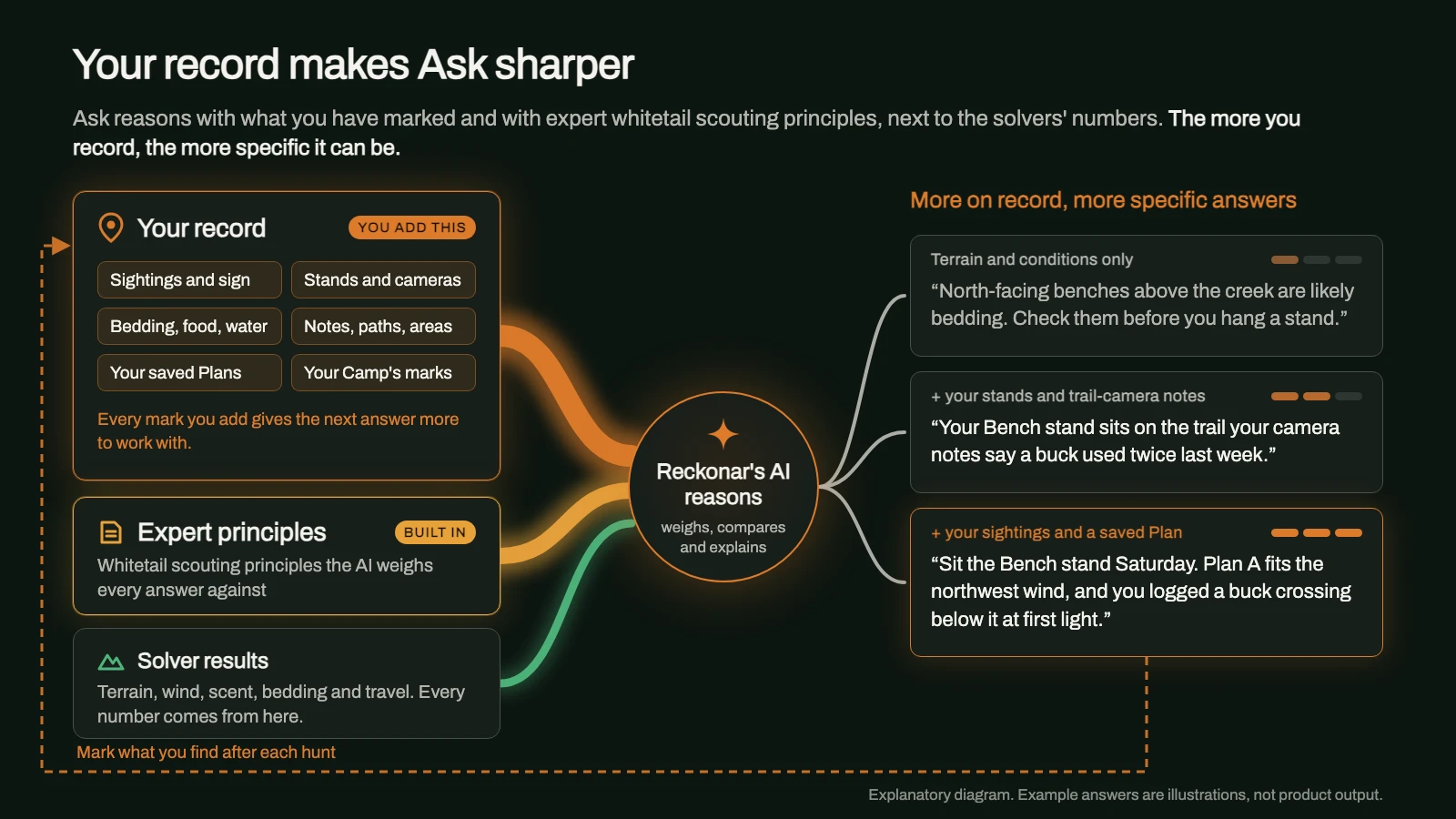
- 02Your record and expert whitetail scouting principles carry real weight in every answer. The more you mark, the more specific Ask can be.
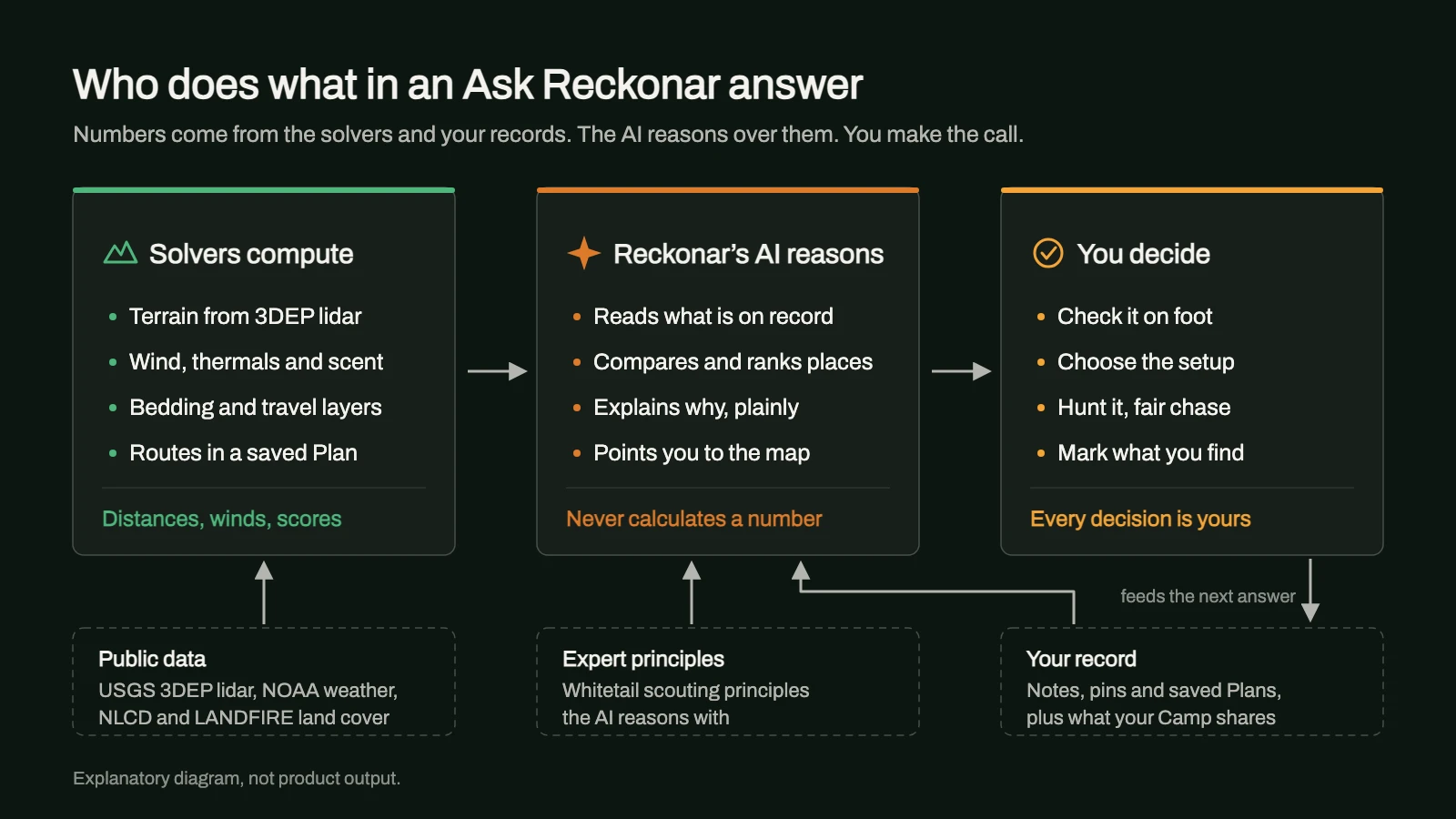
- 03The language model explains and weighs evidence. Every number in an answer comes from a solver, a saved Plan or your own notes.
- 04Ask is implemented and partly tested, and quality improvements are underway with experienced hunters.
Solvers measure, the AI explains
Language models are unreliable at measurement. A chatbot asked how far a bench sits from your truck may invent a confident number, so Reckonar keeps measuring out of the model’s hands.
Deterministic solvers build the terrain from USGS 3DEP lidar and model wind, scent, bedding and travel. Given the same inputs, a solver returns the same result every time. Ask weighs those results and your records against expert whitetail scouting principles and explains which ones matter for your question. Any distance, wind or score it quotes traces to a solver output, a measurement Reckonar’s code made on the map, your saved Plan or a note you wrote. A figure that cannot be traced is held back before you see the answer.
The more you record, the better it reasons
On new ground with nothing marked, Ask can only read the terrain and conditions, so its answers stay general. Every sighting, rub line, stand, camera note and saved Plan you add gives it something specific to weigh, so it can tie its advice to what you saw and check a hunch against what you logged last week. Expert whitetail scouting principles are the other half. Ask weighs your record and the solvers’ results against them to explain why one setup beats another.
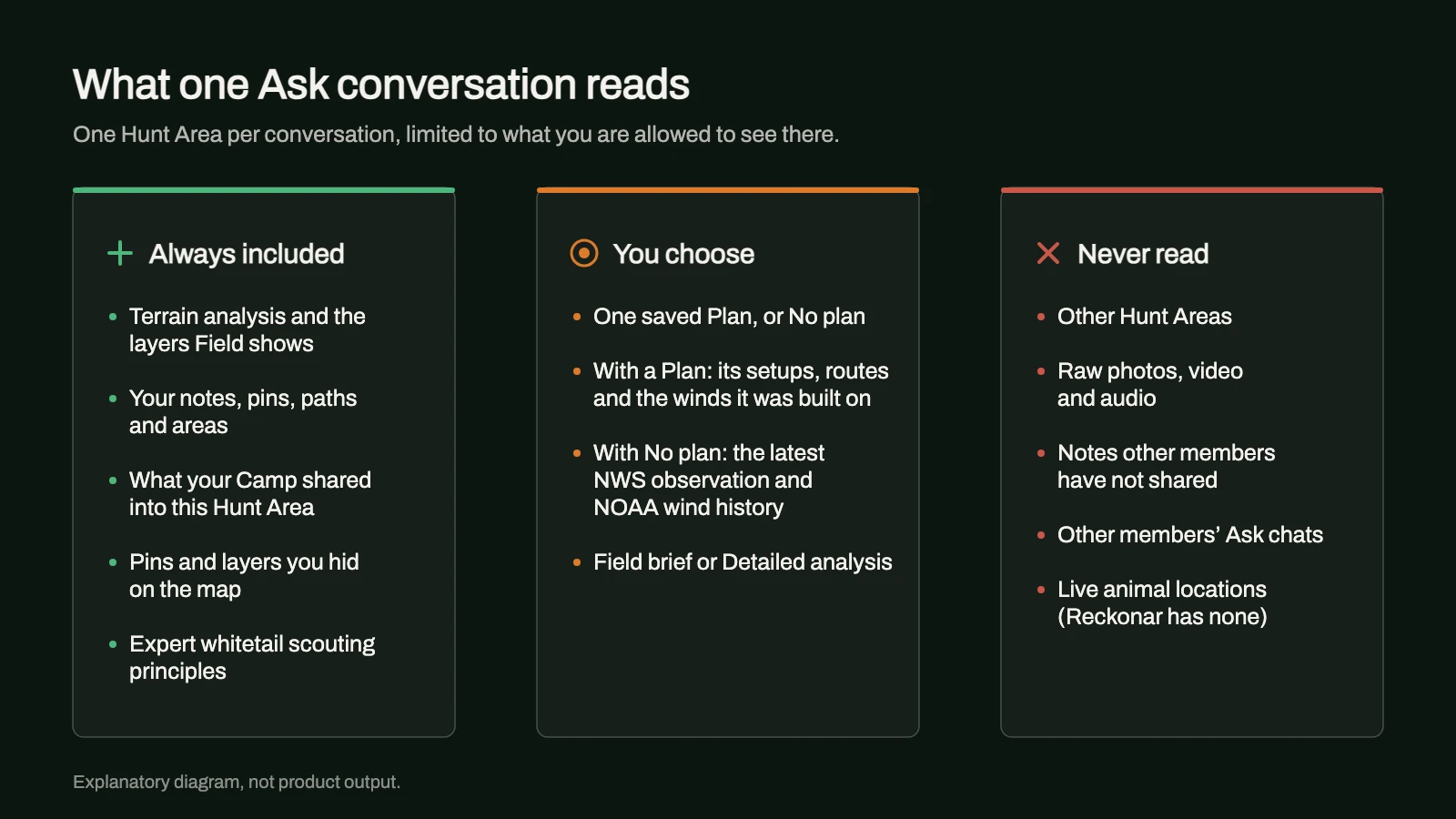
With no Plan selected, Ask works from the terrain analysis and your notes. It adds the latest National Weather Service observation and the area’s wind history for the current calendar month from NOAA station records, and it does not present that history as a forecast.
Answers that point at the ground
An answer opens with the short answer, then adds parts headed Where to look, Why and Next move where they help, much like a briefing at the truck. Places named in the text are tappable, and so are the layers it cites.
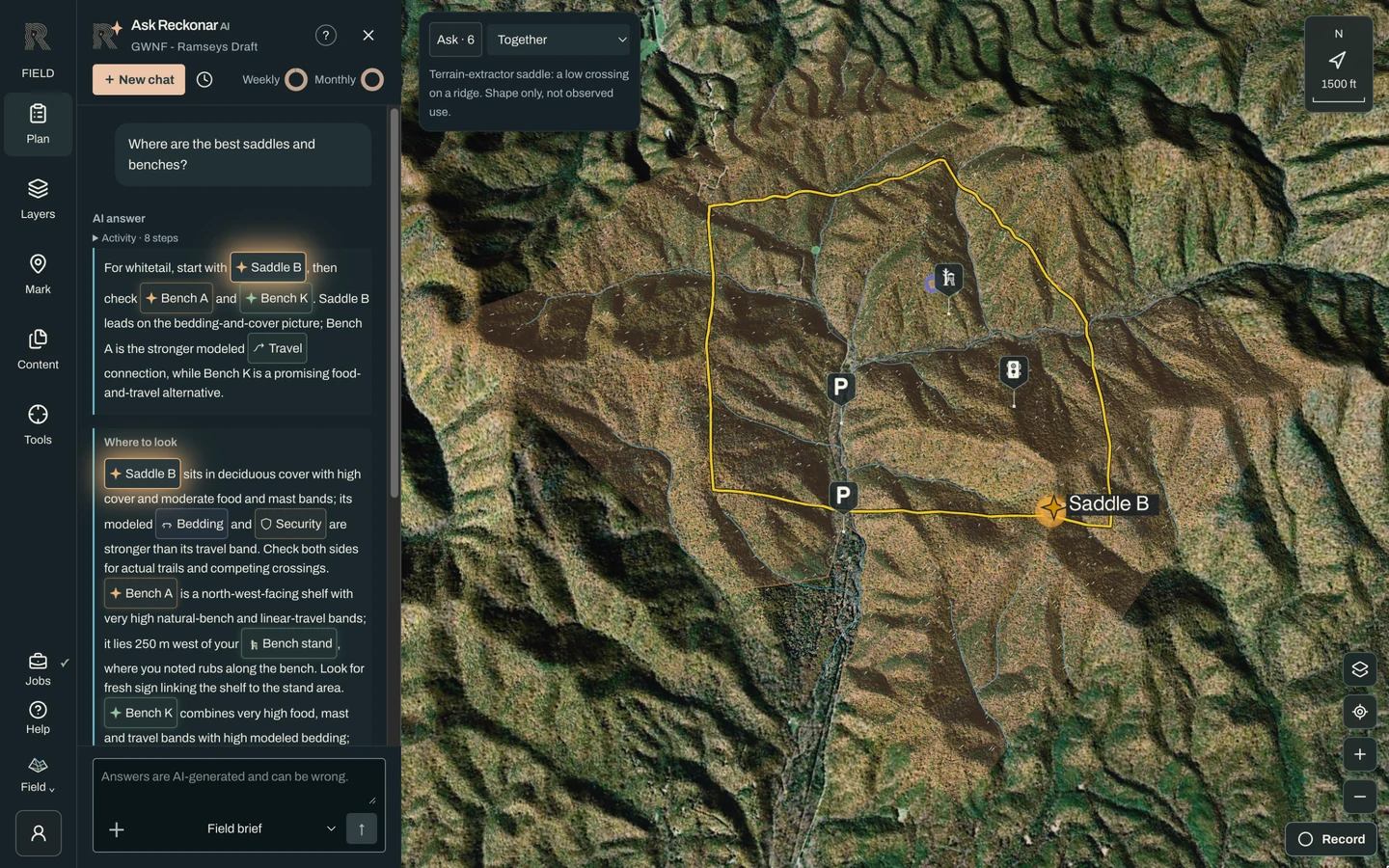
A starred place is a lead for you to check on foot. Its outline is a rough sketch around evidence the answer cited, and it is never saved as your content.
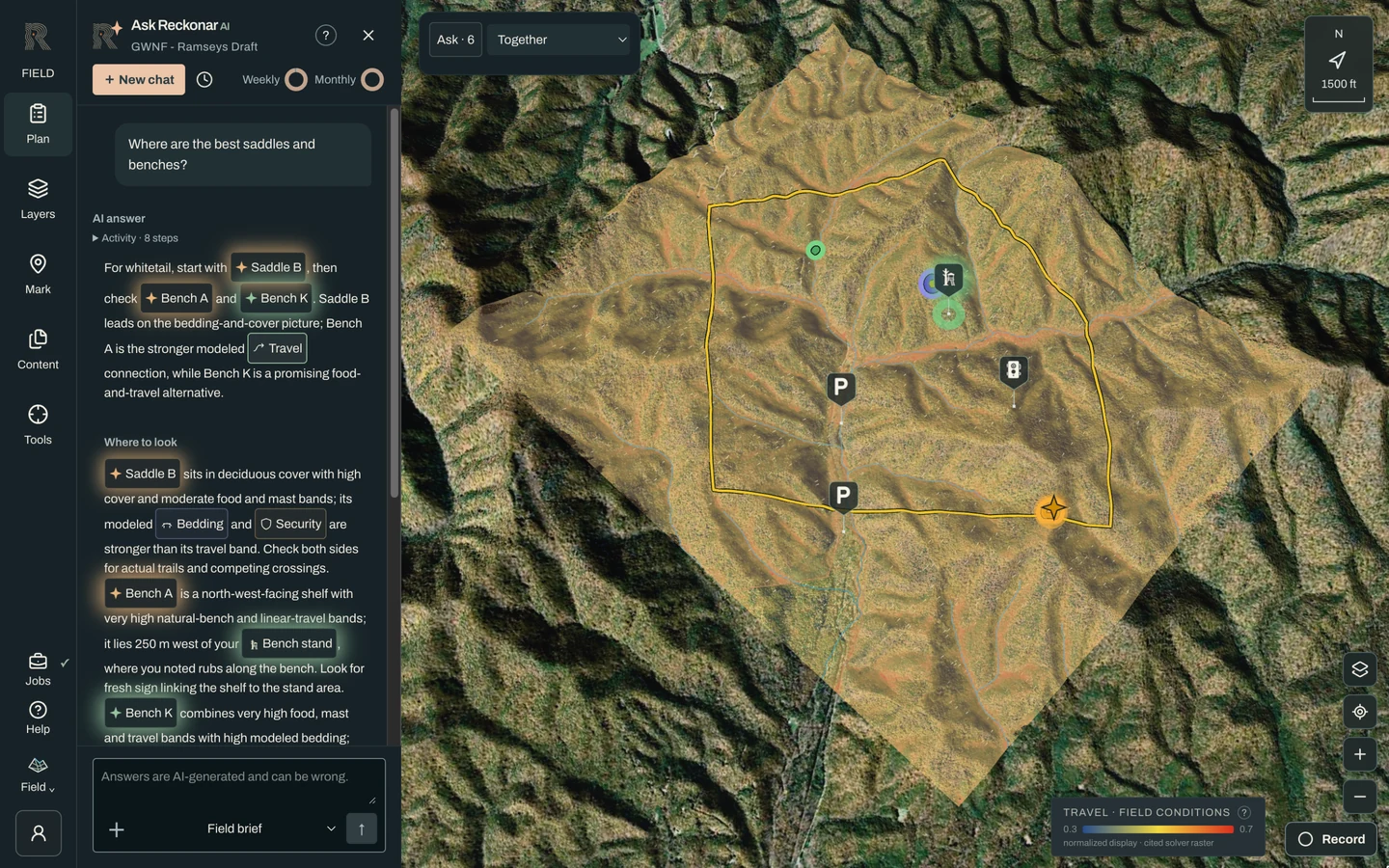
Ask is built to explain its reasoning. A good answer says why a bench above a crossing might outrank a spot beside your parking, and when a single sighting is still short of a pattern. It is a tool for the night before a hunt or the evening back at camp. Reckonar has no live animal data, and Ask does not coach you during a sit.
Depth, allowance and privacy
Field brief is the default depth. Detailed strategist analysis goes deeper and uses more of your allowance, and rereading a saved answer costs nothing.
Your Ask conversations are not shared with your Camp, even in a Hunt Area you share with it. Reckonar keeps them so you can reopen them, and Reckonar staff may review them to support and improve the product, as our Privacy Policy describes.
Commercial AI providers generate the answers under terms that restrict training on your content, and Reckonar does not opt it into provider training. Providers may keep some data for security, abuse prevention or temporary caching. Reckonar’s own in-house model training is a separate Data defaults setting. It is on by default for new accounts, and you can turn it off at any time. It never lets a third-party provider train on your content.
What we don’t claim yet
- Ask is implemented, and the parts that read terrain and tie numbers to sources have automated tests. Quality improvements are underway with experienced hunters.
- The checks confirm that figures, dates and places match their sources. They cannot confirm every line of reasoning, and a loose word like “nearby” can slip through.
- Ask needs a connection and does not work offline.
Where to find it in Reckonar
In the web app, open a Hunt Area in Field, then Plan, then Ask Reckonar. Starter chips such as “Give me a first read of this land” help with a first question. Jobs shows answers that are still running, and History keeps your chats for each Hunt Area. Record what you see with Mark so the next answer has more to work with, and rate each answer Helpful or Not helpful so we can see where Ask falls short.